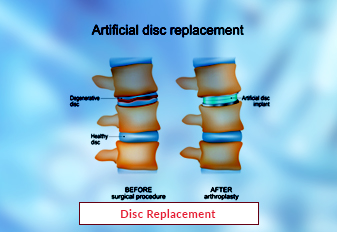
Your surgeon will remove a damaged spinal disc and replace it with an artificial one during disc replacement surgery. The cushions of rubber that are located between your vertebrae are called spinal disks. It allows your body to move, bend, and twist easily. There are three main types of artificial disc replacement surgery. These types of surgery use materials which include cobalt, titanium and stainless steel. These materials play a vital role in the longevity and function of the implant. Depending on the patient’s condition, the surgeon may decide the best treatment method.
Disc replacement is appropriate for people who have normal spinal motion and little or no arthritis. Patients with taller spinal discs may make better candidates as compared to those with shorter discs. This is a major surgery with the success rate quite high. It has been observed that in more than 90% of patients the artificial disc replacement lasts more than 10 years and most likely for the rest of one’s life. According to simulated wear studies, artificial discs might last at least 40 years, and possibly up to 100.
Who Needs to Undergo this Surgery?
Certain factors may make you suitable this procedure that include:
- Back pain that is continuous and prolonged. Also is not responding to other treatments.
- You are between 18 and 60 years of age.
- Individuals who have degenerative disc disease that is non-responsive. It is persistent for at least 6 months after going through a non-surgical therapy.
- You do not have any arthritis and your spinal movement is good.
Benefits of Disc Replacement
This medical procedure provides a number of advantages that include:
- Pain relief
- Spinal mobility and its preservation
- Quick recovery
- Reduced Risk of Side-by-Side Segment Degeneration
- A better quality of life
Risks and Complications
As with any surgery, this medical procedure may also cause some complications in patients that include:
- Infection
- Loss of blood
- Nerve injury
- Problems in breathing
- Eroding out or breakage of the disc’s components
- Implant getting dislocated
- Injury to vertebra to which the disc replacement is applied
- Sensitivity to the artificial disc’s materials
Procedure of Disc Replacement Surgery
Depending on the symptoms, your doctor will guide you to the best treatment suited for you.
Before the Procedure
Prior to your medical surgery, you will consult with your surgeon. Expect your surgeon to:
- Take a physical exam.
- Inquire about your medical history and symptoms.
- Request imaging testing for your neck, such as an X-ray or MRI.
- Inquire about the medications or supplements you take.
- Change your pharmaceutical plan, such as removing or adding specific medications.
- Do not stop taking the drugs unless your surgeon instructs you to do so.
During the Procedure
Before the procedure, your surgeon will review the below guidelines with you that include:
- A general anesthetic that will make you numb and asleep. It will make you painless during the procedure.
- Later, your surgeon will make a cut in the front of your neck. Your health condition will decide the length of the cut. The medical team will move your trachea and esophagus to one side if needed.
- For a better picture, your surgeon will use imaging guidance known as fluoroscopy.
- The damaged disk will be removed and replaced with an artificial one.
- Once the medical procedure is successfully completed, your surgeon will close the incision.
After the Procedure
After the surgery, your health care team will shift you to a recovery room. Here, you will be monitored for different vital signs. You may feel some pain that is normal and some painkillers may be given to you. Your doctor will tell you to follow some guidelines that include:
- Taking drugs on time to reduce the pain.
- Stay away from physical activity like lifting heavy objects.
- Incision area should be protected from water, dirt.
- Taking part in physical therapy.
Recovery and Care
Typically, patients can carry on with their day-to-day activity between six and eight weeks after this surgery. For the first four weeks after surgery, rehabilitation may consist of a self-directed exercise program, such as walking and stretching. Following this period, a strengthening program may be prescribed. Your doctor will talk with you about returning to sports and other physical activity. Most patients can function at home without additional assistance. However, it is recommended that you prepare your home and meals ahead of time for the first few days following returning from the hospital. Patients can take showers five to seven days after surgery, and a shower stool is recommended.