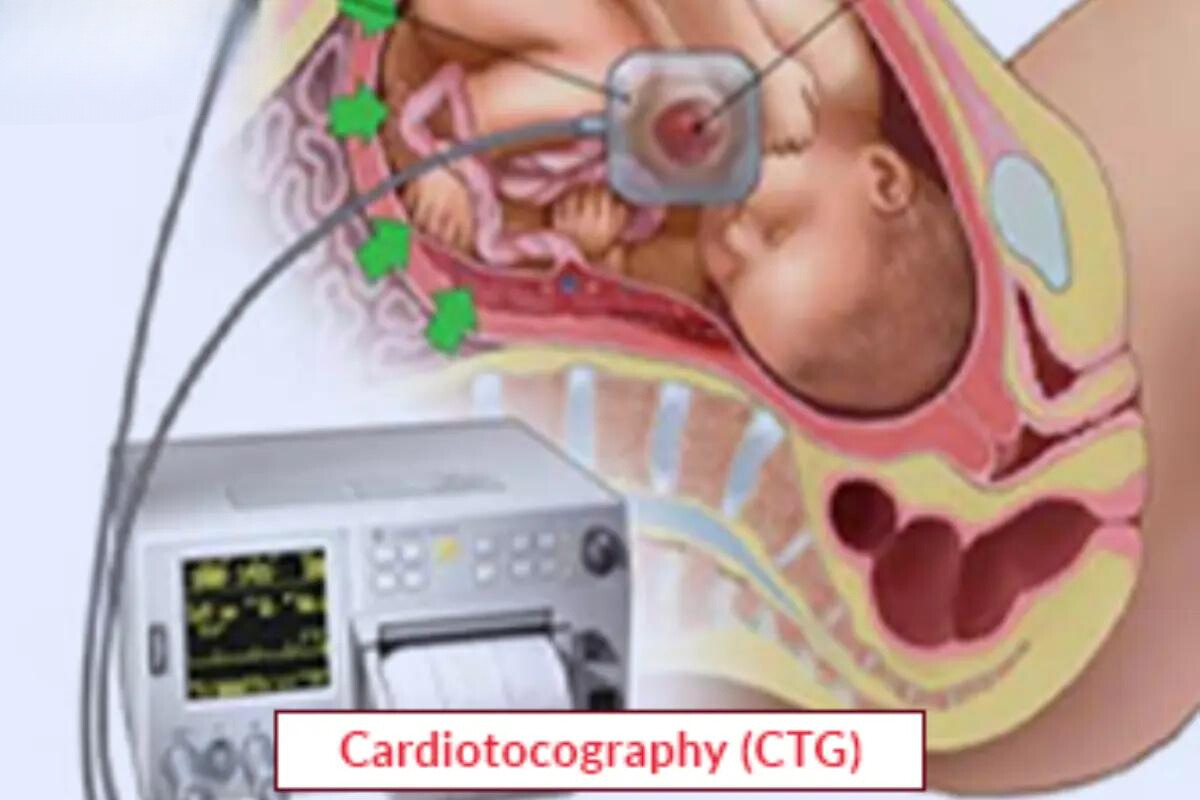
During the time of pregnancy, especially in the final months, at that time, regular monitoring of the baby’s health becomes very important. Cardiotocography is a very easy test that is used to check the baby’s heartbeat and the mother’s uterine contraction. It helps doctors to know how well the baby is doing inside the womb and whether there are any signs of stress or discomfort.
The monitoring of CTG is play the very crucial role in both normal and high risk pregnancies. It allows early detection of any problems so that timely care will be provided. The test is so safe, painless and its give the fast results, which helps to make better medical decisions. At Healthcheckbox, we help you to access the best CTG monitoring with the experienced healthcare professionals and well-equipped facilities. We also ensure that every patient will get the proper care, a good outcome and complete support for both mother and baby throughout their journey.
Purpose of CTG Test
This test is mainly used to monitor the baby’s health and detect any possible issues early. In the section, some imporant purpose of the CTG test are given, such as:
- Monitor baby’s heart rate: This test is detect that how fast or slow the baby’s heart is beating.
- Check uterine contractions: It shows how often contractions are happening and how strong they are.
- Detect fetal distress: It helps to identify whether the baby is getting enough oxygen or is under stress.
- Track baby’s movement response: The heart rate of the baby is usually changes with the movements, which is a good sign of health.
This basic information helps to every doctor to decide whether everything is normal or extra care is needed or not.
Types of Cardiotocography
There are mainly two types of CTG monitoring, which are:
- External CTG: This is the most common type of CTG. It is completely non-invasive. At this, the sensors are placed in the mother’s abdomen to detect the baby’s heartbeat and contractions. It is such a safe and comfortable process.
- Internal CTG: This type is used for special cases during labor. A small electrode is attached to the baby’s scalp to get more accurate readings. This process is only done when it is necessary.
When is CTG Recommended?
CTG monitoring is required in many situations, such as:
- In the third trimester of pregnancy.
- If the mother feels reduced baby movements.
- In high risk pregnancies.
- If the mother has conditions such as high blood pressure or diabetes.
- When pregnancy goes beyond the due date.
It helps to monitor the baby’s condition and take action if it is required.
How is the CTG Test Performed?
There are CTG tests given which are performed during that time, such as:
Before the Test
- There is no specific preparation needed.
- The test will be taken for around 20 to 40 minutes. So, it is suggested to every patients that eat a meal and use the restroom beforehand.
- After that, the mother is asked to lie in a comfortable position.
- The doctor will place two transducers, which are sensors on the mother’s abdomen, held in place by elastic belts.
- The conductive jelly may be applied to the skin to enhance the signal strength.
During the Test
- During the test, the machine will monitor the baby’s heart rate.
- In most cases, patients will be given a button to press whenever they feel their baby move, which is the marks the start to check how the heart rate responds to movement.
- Then, if the baby is asleep they may try to stimulate the baby, for example, by gently moving it.
- At that time you will hear the baby’s heartbeat as a pulsating sound.
After the Test
- After the test, the belt and transducer are removed.
- The results are printed as a graph.
- The doctor reviews the pattern carefully.
- Further steps are suggested if needed.
The entire process of CTG is painless, very simple, and it does not harm either the baby or the mother.
Interpretation of CTG Results
The result of CTG is shown as a graph which detect the baby’s heart rate and the mother’s contractions over time. The doctors will study this graph carefully to know how the baby is doing inside the womb.
- Baseline Heart Rate: This is the average heart rate, which is mainly between 110 and 160 beats per minute.
- Variability: This shows the small changes in the baby’s heart rate. The good variability means the baby is active and healthy.
- Accelerations: It is a temporary increase in heart rate, which occurs only when the baby moves. This is a positive sign.
- Decelerations: It is drops in heart rate. Some of the types are normal, but repeated or deep drops may need proper attention.
- Contraction Pattern: It shows how often and how strongly the contractions are, mainly during labor.
According to these factors, the CTG results are classified as:
- Normal (Reassuring): That means the baby is healthy.
- Suspicious: It needs closer monitoring.
- Abnormal: It may require sudden medical care.
Only a trained doctor can properly interpret CTG results and decide the next steps.
Benefits of CTG Monitoring
The benefits of CTG monitoring are provided in many important areas:
- Ensures baby’s safety: It helps to check the baby’s health condition and ensure they are getting enough oxygen.
- Early detection of problems: It identifies the problem before they become serious.
- Guides medical decisions: It helps doctors to decide whether a sudden delivery or further care is needed.
- Non-invasive and painless: The external CTG is completely safe and comfortable.
- Continuous monitoring: It is especially used during labour to track the baby’s condition in real time.
Why Choose Us for CTG Monitoring?
Choosing the right place for CTG monitoring is very imporatnt to ensure the best results and peace of mind. In the points below, some points are mentioned which were provided by the Healthcheck box, such as:
- There are well-skilled professionals available who carefully monitor and provide the best results.
- Modern technology is used for accurate and reliable readings.
- We focus on making mothers feel relaxed and safe.
- The doctors will make timely decisions.
At Healthcheckbox, we aim to provide safe, accurate and stress-free CTG monitoring in India or internationally.