

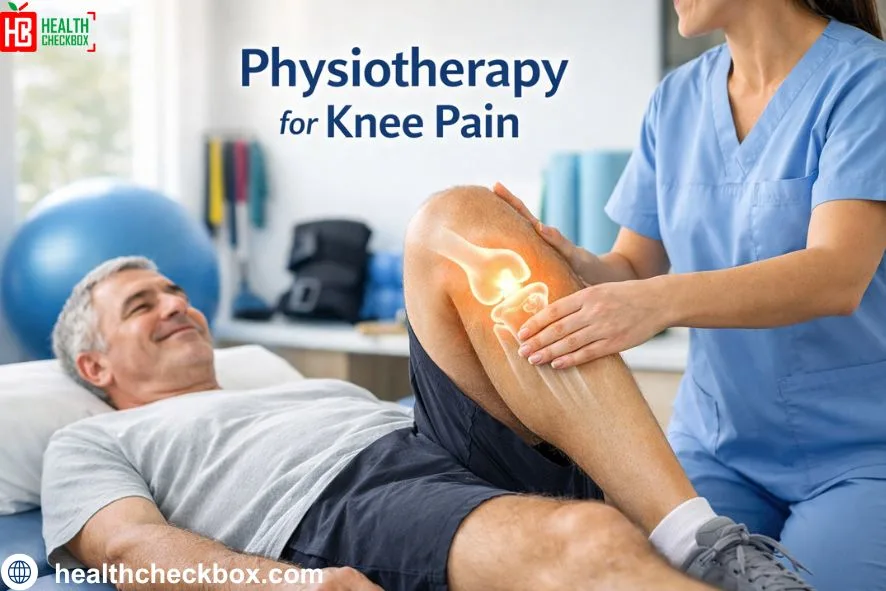
Knee pain happens around the knee joints. It happens when we do some activities like climbing, running, etc. In that case, doing exercise, rehabilitation, and physiotherapy for knee pain will give a proper recovery. The purpose of doing the therapy is to keep your knee strong, healthy and improve mobility. Some exercises target the muscles around the knees, and they help to improve in a great way. It makes everyday life activities less painful and helps to prevent the injuries that can happen due to daily routine.
In this blog, we will tell you about the role of exercise and physiotherapy for knee pain and knee recovery. Some common knee conditions for rehabilitation and the knee strengthening exercises, which help to overcome the knee pain.
Explaining Knee Recovery
Knee recovery includes things like managing pain, swelling, and using the method of Rest, Ice, Compression, and Elevation. It includes many exercises and physiotherapy for knee pain. Minor knee strains may heal in 2–3 weeks, while ligament injuries or surgeries may take 3–9 months or longer depending on the severity and treatment. It depends on the situation, health, conditions and the person’s ability to improve it.
Common Knee Conditions Requiring Rehabilitation
There are some common knee conditions require rehabilitation:
- Ligament Injuries: It is common in athletes, and these injuries can affect the stability, cause pain and affect the function of the knee. In this ACL, MCL, LCL, and PCL injuries are included. ACL injuries may require ACL surgery in severe cases, especially in athletes or complete tears, while partial tears may be managed with physiotherapy.
- Meniscus Tears: Meniscus tears refer to a tear which is in the cartilage that acts like a cushion for the joint of the knee. It can happen if you are suffering from trauma or degeneration with age. This causes pain, swelling and difficulty in moving the knee.
- Patellofemoral Pain Syndrome: This syndrome mostly happens in the runner’s knee. This condition can cause pain around the kneecap because of overuse. It occurs due to improper tracking of the kneecap, muscle imbalance, or overuse.
Symptoms that Affect Knee Mobility
Symptoms that affect knee mobility can occur due to several conditions such as arthritis, ligament injuries, meniscus tears, or patellofemoral pain syndrome.
- Pain: It is the most common and noticeable symptom because it can occur instantly and continuously, and can come or go. This can be worse when you move or sit for a long time.
- Stiffness: Morning knee stiffness is the most common problem. When you sit for a long time, your knee can feel a little heavy. This makes your legs unable to move properly.
- Reduced Mobility: You can face problems in moving your body while doing strengthening or bending. Arthritis can also increase the stiffness, damage the joint and make it harder for you to move your knee.
- Weakness or Instability: In this, you might feel weak throughout the day. It is caused when the muscles which is around the knee are not strong enough, like before or maybe the structure of the joint has changed.
- Deformity: In many situations, arthritis can cause changes in the shape of the knee and can lead to a visible deformity.
Importance of Exercise in Knee Recovery
Exercise is important for the recovery from surgery, injury or healing of the knee from a fracture. It helps to regain the strength and movement of the knee. The exercise should be started gently and not cause any pain. It is easy for you; you can increase the number of exercises. It helps you to improve the strength and make the knee more flexible. It is important for you to reduce the pain, increase stability and restore mobility after your knee is affected. Exercise helps in knee recovery by building strength in the muscles to help them to reduce the pressure in the knee. It improves the mobility and the flexibility while targeting some exercises which help to restore the motion and prevent stiffness.
Role of Exercise in Knee Recovery
Exercise plays an important role in knee recovery like pain reduction, restoring movement and building the supportive muscles. Some exercises also include stretching and aerobics to improve the motion and prevent further injury. It improves the flexibility, reduces the stiffness and increases the functional range. If you do activities like walking, swimming, running or cycling, it will help you to improve your cardiovascular health and help to strengthen the muscles without any impact on your joints.
Role of Physiotherapy in Knee Recovery
Physiotherapy is also known as physical therapy. This treatment helps to improve your body performance. Physiotherapy is commonly used after many surgeries. It uses different physical methods like exercise, massage and other modalities which help to treat the injury and illness. Physiotherapy plays many roles, such as pain relief, improving the movement of muscles and preventing injuries.
- Pain Relief: They include many therapies and an ultrasound to help relieve the pain.
- Improving the Movement: Knee pain always reduces movement because of stiffness, swelling and pain. Physiotherapists suggest different stretching and exercises for flexibility. It also helps patients to walk without anyone’s help.
Physiotherapy Techniques for Knee Pain Recovery
- Pain Management Therapy: In this, the therapist applies the ice or heat pad to reduce the pain, swelling, and inflammation. We also called this procedure cold and heat therapy for knee pain.
- Manual Therapy: In this, the therapist applies the ice or heat pad to reduce the pain, swelling, and inflammation.
- Strengthening Exercises: It targets the exercises that help to build the muscles to support it around the knee, make it stable and reduce the strain.
- Stretching Routines: In this, you have to stretch your muscles to improve flexibility, reduce tension and relieve knee pain.
- Taping Techniques: This is the supportive taping, which helps to stabilise the knee and manage the knee pain that occurs during any movement.
- Electrotherapy: It is the therapy which gives electrical treatment to relieve pain.
Best Exercises of Physiotherapy for Knee Pain
Physiotherapy help to improve your muscles and joints. It manages the balance of the joint and reduces discomfort. The treatment of knee pain combines the techniques of several conditions, such as stretching, strengthening, and electrotherapy, etc. If you face any of knee pain symptoms, then you can do these exercises that includes the techniques of knee recovery to improve your knee pain :
Standing Quadriceps Stretch
In this exercise, you feel stretched in the front of the thigh, the quadriceps. You don’t need anything to do this exercise. You should do 2 sets of 10 things, 5 days a week. So, you have to do the following:
- Hold the chair or wall for support.
- Then, hold your ankle and pull your knees up.
- Make your heel towards your hip.
- Be like this for 30 seconds.
- Do not twist your back.
Straight Leg Raise
This exercise helps strengthen the front of your thigh, the muscles of the quadriceps, without harming or straining the knees. It helps those who have less mobility and pain in the knees. You can put extra weight on the ankle. If you are starting, you can add 5 lb, and if you are increasing the weight, you can add 10 lb. You have to do 3 sets of 12 for 4 days per week. So the things you have to do are:
- Lie on the floor on your back.
- Keep one leg folded, and the other leg straight.
- Keep your elbows under your shoulders.
- Then, lift your normal leg.
- You have to keep your leg straight for this exercise.
- Hold your legs for 10 seconds.
- Do not stretch your neck much and relax your shoulders.
Heel Cord stretch
In this, you can feel the stretch in the two muscles, the Gastrocnemius and the Soleus. You don’t need any equipment for this exercise. You have to do 2 sets of 4 for 6 to 7 days per week. So what you should do is:
- Stand facing a wall and fold your knee of the normal leg forward and the abnormal leg straight behind you. Your heel should be flat.
- Second, keep both hands on the wall, and your heels should be flat. After, press your hips towards the wall.
- Be in this position for 30 seconds.
Supine Hamstring Stretch
While doing this exercise, you should stretch the back of your thigh and knee, the hamstrings muscles. In this exercise, you don’t need anything. You can do 3 sets for 6 days per week. So what you have to do is:
- Lie on the surface with both legs bent.
- Lift your one leg towards your chest.
- You should keep your hands behind your thigh for support.
- Then, straighten the leg and pull it towards your head.
- If you have any problem or are facing any difficulty while holding or keeping your hands behind your thigh, then you can use a towel.
- Be in this position for 30 to 50 seconds.
- You should not put your hands on your knees and pull.
Calf Raises
While doing this exercise, you can feel the stretch in your calf, the muscles of the gastrocnemius and the soleus complex. You only need a chair in this exercise for support. You have to do 2 sets of 10 for 5 to 6 days a week. So, the method of doing this exercise is:
- You have to stand and keep your body weight on both feet and hold the chair or wall to maintain the balance.
- Raise your unaffected foot in a backward direction; in that way, all the weight takes place on the affected foot.
- Then lift the heel of the affected foot as high as you can, and then lower it.
Hamstring Curls
At this, you should stretch the back of your thigh, the hamstrings muscles. If you want to increase your strength, then you can put a 5 lb weight on your ankle, and after some time, you can add a 10 lb weight. You can do 3 sets of 10 for 6 days per week. So, you have to do the following:
- Hold the wall for support.
- Fold your affected knee backwards as far as you don’t feel pain.
- Be in this position for 5 sec.
- Stretch your foot and keep both knees together.
Hip Abduction
During this exercise, you can feel the stretch in your thigh and hip, the muscles of the abductors and the gluteus. After it becomes easy for you, then you can put weight on the ankle. At the start, put 5 lb and after some time, if it becomes easy, then add extra weight. You can do 3 sets of 25 for 3 to 4 days per week. So all you have to do is:
- Lie on that side so that your injured leg can move in an upward direction and your other leg can be bent so that it gives you support.
- You have to straighten your upper leg and knee.
- You should stay in this same position for 5 seconds.
- After that, relax for 2 seconds and repeat it.
- To raise it higher, don’t rotate your leg; it will affect your leg more.
Hip Adduction
In the process of this exercise, you can feel the stretch in the inner thigh, the muscles of the adductors. To increase your level, you can put weight on your ankle. At the start, you can add 5 lb and after that, 10 lb, when you want to add extra weight. Do 3 sets of 12 for 5 days per week. So, you should:
- Lie on the floor on the side of your abnormal leg in a straight position.
- Then, keep your normal leg in front of the abnormal leg.
- After that, raise your affected leg.
- Be in that position for 5 seconds.
- At last, lower your leg.
Tips for Safe Knee Rehabilitation
There are many tips by which you can manage your knee safely:
- Use support while walking to reduce pressure on the knee and maintain balance.
- Wear any braces or splints to support your knees, and you should only remove them to maintain hygiene.
- You should avoid “HARM” (Heat, Alcohol, Running/sport and Massage) during the first 48–72 hours after a knee injury to prevent swelling and further damage.
When to Consult a Physiotherapist for Knee Pain?
The knee pain occurs because of your daily activities like walking, doing extra exercise and many more things. You should not ignore it and go to a physiotherapist to receive physiotherapy for knee pain if you are suffering from:
- The pain has been staying for more than 1–2 weeks and is not improving.
- The knee is swelling, and not improving or worsening the condition.
- If you are feeling any sensation in your legs or knees.
- The colour of your knees, legs or toes is changing as if it is very red, white and blue.
- If the pain is getting worse and you are not able to bear the weight in your injured leg.
Conclusion
We hope that you understand the role of exercise in knee recovery and the role of physiotherapy. There are also so many techniques, exercises and physiotherapy for knee pain, like strengthening exercises, electrotherapy, stretching, and many more techniques. And the exercises are leg extension, straight leg raise, hip adduction, and many more. There are also some tips by which you can take proper care of yourself.