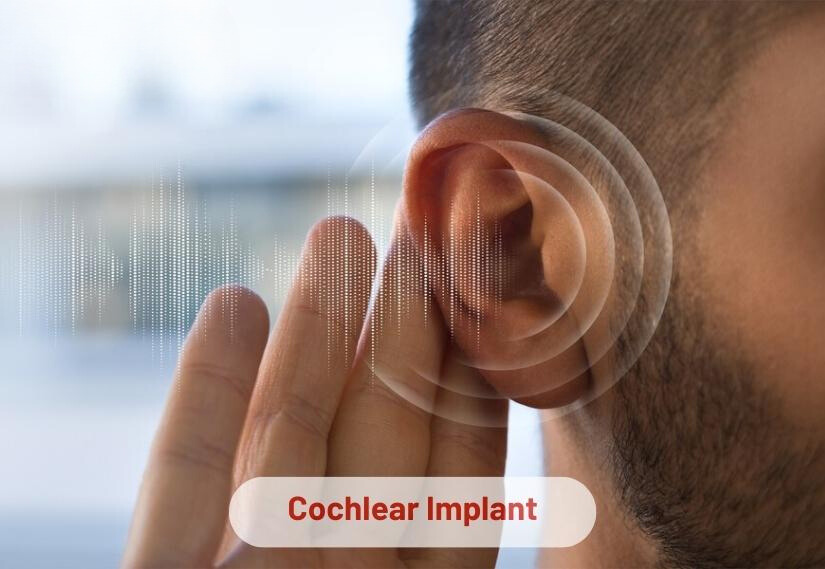
Cochlear implant surgery procedure is carried out to restore hearing loss in people who have hearing problems or are those who are affected by severe hard-of-hearing. A cochlear implant is placed inside the ear, unilaterally or bilaterally as the case may be, in a hospital or clinic, and general anesthesia is administered to the patient to relieve him or her of the discomfort and pain during the surgery.
The hearing sound is greatly improved, and people who undergo these cochlear implants improve in their power to comprehend speech and hearing quality. The surgery creates a new pathway into the patient’s ear. This new pathway easily moves sound from the outer ear to the inner ear.
Types of Cochlear Implants
These implants differ mainly on the basis of the external sound processor. Location of this sound processor is important, and the audiologist will rightly decide the best option for the location. The processor may be placed as:
- Rear of the ear
- On the scalp
- Attached to the clothes
Why Do People Go for Cochlear Implants?
Causes of hearing loss may opt a person for cochlear implants that include:
- Loud noise
- Hereditary factors
- Age
- Ear infections
- Earwax
- Medications, including chemotherapy drugs and certain aspirin
Benefits of Cochlear Implant Surgery
Many advantages come with the cochlear implants, which are aimed at addressing communication and speech that including:
- After the implant, the patient is able to speak and comprehend in an effective manner.
- Increased ability to hear daily sounds,
- Increased lip-reading ability,
- Increased ability to use phones, detect, and better respond to audio and video devices, such as doorbells, ringing phones. Some people may be able to use a phone without any aid, while others may need some help.
Procedure of the Cochlear Implants
This implant can take place in-clinic or in a hospital. Typically, the procedure lasts for 2 hours, and the patients are administered anesthesia so that they do not feel the discomfort of surgery.
During the Cochlear Implant
- The surgeon makes a small cut in the back of the ear to suitably insert the implant.
- An opening is made in the bone that lies just behind the ear, which links to the cochlea.
- The opening is made to place the electrode inside the cochlea.
- With the help of surgical threads, i.e., sutures, the incision is closed, and now the patient is shifted to the recovery area.
The patient is monitored for some time, and takes some time to heal the incision. The patient should not wear any hearing aid during this time.
After the Surgery
After nearly 15 days of the surgery, a follow-up with the audiologist may be of help that will:
- Insert the sound processor to fit it suitably.
- Look for the working of transmitter and electrodes.
- Turn the device on to assess if the patient is able to hear properly or not.
As hearing is an involuntary action and is an outcome of the activity when brain and ears function in their normal way, so most people with cochlear implants may need to work with a speech language pathologist (SLP) so that the brain is able to understand the sound.
Working Life of Cochlear Implants
Normally, the transmitter and electrodes are able to last life long. The outside parts-the sound processor and microphone-have a working life of 5 to 10 years.
Risks or Complications Associated with this Type of Implant
- Residual Hearing Loss: This characterizes the ability to hear without the means of hearing aids. Hearing is a process where nearly 20,000 tiny hair cells in the cochlea change the mechanical vibrations into electrical nerve pulses so that the brain is able to realize them in the form of sound waves. Sensorineural hearing loss is a result of the damage to hair cells.
- Meningitis: On very few occasions, people with unusual ear structures may form meningitis. In such a case, getting vaccinated against the spread of this disease decreases further risk of development this condition.
- Nerve damage: Sometimes the cochlear implant surgery can cause harm to the nerves that run through the middle ear and to the point where the implant needs to be placed. If this is the case, one can have problems with taste, one side of the face getting weak with the implant, or a feeling of numbness for the whole year. Worsening or new case of ringing in the ear, also known as tinnitus. Continuous pain, numbness, or headache at the point of the implant.
Considerations with a Cochlear Implant
One has to live with an implant for life, for which you may need to work with audiologists and surgeons on a regular basis. You will have to consult the audiology team to ensure that:
- Implant is in perfect condition.
- The skin at the location of the magnet is in a healthy state.
- Certain medical tests and examinations, such as radiation therapy, electrical surgery, or neurostimulation, may be needed.