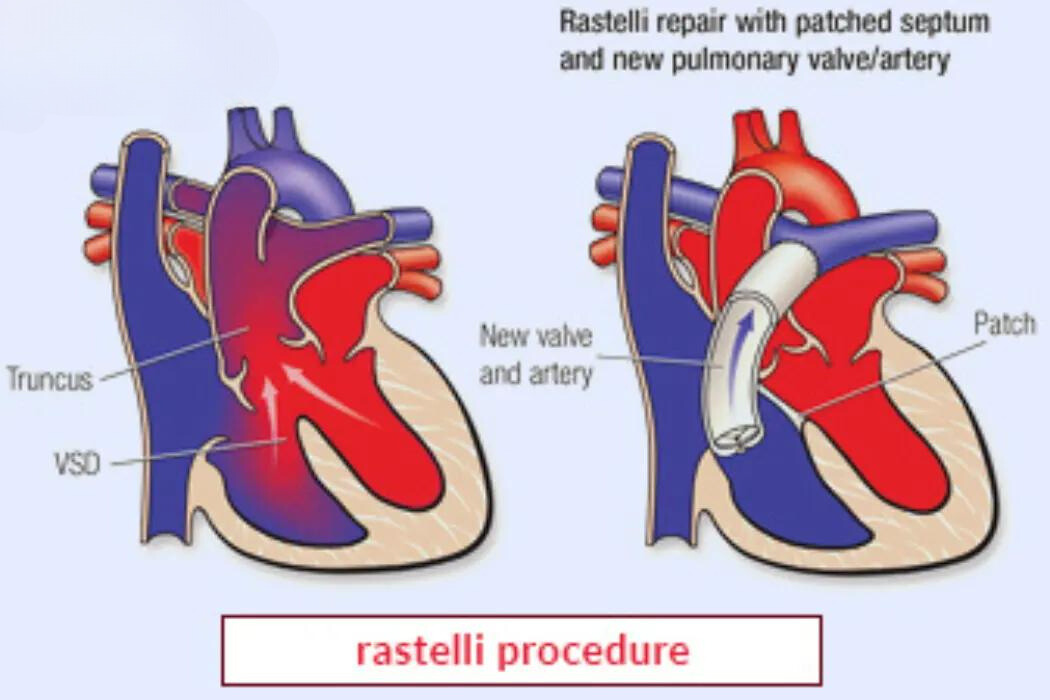
The Rastelli procedure is an heart surgery that is normally carried out in infants and particularly young children to treat congenital heart defects (CHDs) that occur at the time of birth. It can vary from mild to severe conditions and can adversely affect the heart valves, walls, and blood vessels.
The Rastelli procedure is complex in nature and involves the reconstruction of the heart and subsequently repairing it. This is the standard treatment for:
- Transposition of great arteries (TGA)
- Ventricular Septal Defect (VSD)
- Pulmonary stenosis
This is a surgery that involves low risk. But still, factors such as advanced mortality, re-operation, and late complications have to be considered before the surgery.
When to Go for the Rastelli Procedure?
Infants with congenital heart defects are more likely in need of this surgery, which includes:
- TGA, VSD, and pulmonary stenosis
- Tetralogy of Fallot
- Pulmonary atresia showing ventricular septal defect
Babies who show the above symptoms normally have temporary repairs just after birth. When a shunt tube or a conduit is placed to raise the flow of blood to the lungs. And later, when the child becomes stronger and bigger, around 1 to 2 years old Rastelli procedure is carried out.
Process of Rastelli Procedure
The main goal of the Rastelli procedure surgery is to ascertain certain abnormal conditions in the heart. So that it can function properly and normal circulation in the heart is brought back as soon as possible.
Anesthesia and Incision
Initial step in the surgical operation, and no later than the infant is under the effect of anesthesia. A cut is made in the chest to look for any defect in the heart and neighbouring areas.
Cardiopulmonary Bypass
A heart-lung machine is connected to the patient, and this temporarily performs the work of heart and lungs during the Rastelli surgery. The machine regulates the blood flow and oxygen supply as the heart is cut off to perform the surgery.
Closing of the VSD
The ventricular septal defect is sealed with a synthetic material or the patient’s own tissue. This sealing isolates the ventricles and blocks the mixing of oxygenated and deoxygenated blood.
Outflow Tract and its Reconstruction
The surgeon makes a suitable path for the flow of blood from the right ventricle to the pulmonary artery. A conduit or valve is placed between the right ventricle and the pulmonary artery in the surgery.
Relinking of Aortic Flow
The left ventricle and the aorta are attached in such a way that oxygenated blood is redirected from the left part of the heart to the body’s general circulation.
Closing and Recovery
Once the necessary repairs are carried out during the surgery. The surgeon will thoroughly examine the repaired organs and make sure the blood flows uniformly. The heart is slowly warmed, and the heart-lung machine is also disconnected. The cut is also closed with staples. And the patient is ready to be moved to the intensive care unit so that he or she is monitored and recovers soon.
To monitor the condition of the heart and assess the patient’s recovery, follow-up visits with the doctor are mandatory. Various tests, like an echocardiogram, can be done to make sure the blood flow and heart function are optimum.
Success Rate of Rastelli Procedure
The success rates of the Rastelli procedure in India differ and depend on the infant’s specific diagnosis. Infants who have had this surgery normally lead a healthy life, as this operation is reckoned to be a low-risk procedure in connection to early deaths.
The probability of the surgical valves and other implanted devices over a period of time is less likely to occur. But cannot be ignored totally, so the patient may need another surgery later to repair or replace the conduit and/or valve. The patient may need constant monitoring by a heart specialist in case new problems develop and on reaching adulthood.
Cost of Rastelli Procedure
A surgeon with prior and ample experience in congenital heart repairs needs to carry out this complex operation. Usually it takes 4 to 6 hours for the surgery; that depends on how severe the heart defect is.
India can be an attractive destination for heart surgery and for those who are looking for an affordable operation at a reasonable cost. With the availability of vast and highly experienced medical experts in India and an advanced technology that focuses on patient care, many patients can opt for this surgery in India to benefit from the cost-effectiveness of advanced medical services.