

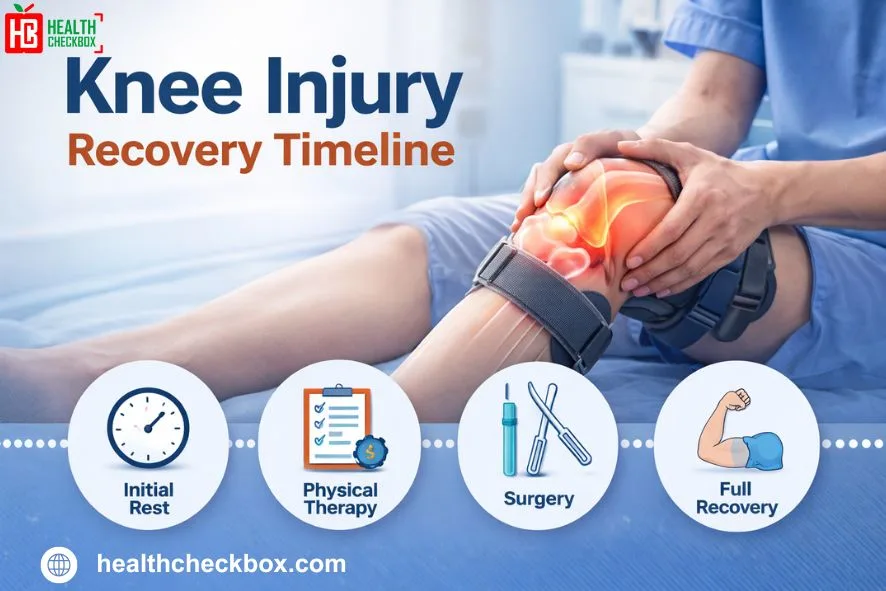
The knee is a complex joint with many soft tissues and ligaments around the joint. This complexity makes it vulnerable to a number of injuries. Knee injuries come in various forms. Some of the common knee injuries are ACL injury, meniscus tears, and simple knee pain which can happen because of high physical activity or an accident. Each type of injury requires a different type of treatment and recovery process. After the knee injury recovery timeline can be lengthy, which depends on various factors.
Knowing the knee injury recovery timeline after the knee replacement surgery or other knee surgery helps the patient to set realistic expectations. They know that the recovery process is long and takes time which helps in managing the frustration. Also, knowing the recovery period beforehand helps in highlighting the necessary physical activity.
What affects the Knee Injury Recovery Timeline?
There are multiple factors that you must keep in mind that can affect the knee injury recovery timeline. One of the major factors is the type of injury you have and other is what type of treatment you are getting.
Common Types of Injuries
The knee is a complex and one of the most important joints of the body. Being one of the most useful and productive joints in the body makes it very vulnerable to injuries. Some of the common knee injuries are mentioned below:
Anterior Cruciate Ligament (ACL) Injuries
This is the most common injury among the athletes as it often happens while doing any sports related activity. This usually happens when there is a tear or a sprain in your ACL. Suddenly changing your direction rapidly or landing in an unorthodox position after jumping can cause this tear to happen. The ACL connects the thigh bone to your shinbone. The recovery time after the surgeries varies from 6 to 9 months. Athletes are given some more extra time off before they can return to their sports back.
Posterior Cruciate Ligament (PCL) Injuries
The posterior cruciate ligament connects your upper leg and the lower leg and helps to keep the knee in its place and helps it to move smoothly. This injury happens when you get a blow to your front knee while your knee is in a bent position. This leads to a sprain or a torn ligament which may cause knee pain. This usually happens while driving motor vehicles or in sports related activities. This ligament has the potential to heal on its own. The recovery time here varies depending on the conditions of the injury, if you have a mild injury, it can heal on its own in around 2–6 weeks. But, in case of treatment the recovery time increases vastly and goes to 6 to 9 months.
Collateral Ligaments Injury
There are 2 types of collateral ligaments. Medial Collateral Ligament (MCL) and Lateral Collateral Ligament (LCL) injuries. When you get a direct blow on your outside knee, due to the force of the blow your knee gets shifted sideways which causes the MCL Injury. In case of LCL Injury you get a blow on the inside of your knee which will push your knee more outwards. LCL is less common than other knee injuries. These injuries usually happen to sportspersons who are involved in direct contact sports like football, hockey, soccer, etc. The estimated recovery time for MCL is around 12 weeks. In case of LCL, if you have a minor injury then it will take around 3-4 weeks, but if your injury condition is severe then it might take over 6 months for surgically repaired tissues.
Meniscus Tear
A meniscus tear is one of the most common knee injuries. It is located in between the thigh bone and shinbone as well as covered by the kneecap which provide it with protection. This injury is commonly seen on sportspeople who play contact sports or on adults over 40 as by age, it starts to degenerate and it is a very common phenomenon. Also, people who had an ACL injury in the past are more vulnerable to this injury. The estimated recovery time for non-surgical treatment to knee surgery is between 4-8 weeks, and for surgical treatment, it will take around 3-6 months.
Fracture
This is the most common bone related injury you will ever see. Patellar Fracture is the most common knee fracture. The patella, or kneecap, is a small bone that is in front of the knee. This acts as a shield of your knee, it is more exposed to taking damage which makes it more vulnerable to fracture. Patellar fracture can be caused by taking heavy damage to your patella like falling directly on your knees or by taking a hard blow on your knee while in a vehicle collision or while playing a contact sport. Patellar Fracture gets fully heal within 3-6 months.
Treatment Approach
There are different types of treatments and each type of treatment can affect the recovery time of a knee injury. Some of the treatment types are mentioned below:
Non-Surgical Treatment
This treatment is done for minor to medium level of injuries like knee sprains, minor tears in your ligaments. RICE method is one of the most used non-surgical methods. You can get fully recovered within 6-8 weeks, which depends on the seriousness of injury and the patient’s health status.
Surgical Treatment
Severe injuries like grade 3 ligament tears (ACL, LCL, MCL,…), Meniscus Tears, and Fractures require surgery to get healed. The surgery can be done either by following arthroscopic surgery or by giving a full open surgery to repair or replace the damaged part of the knee. It will take around 6-18 months time depending upon your injury to fully recover.
Physical Therapy
You need physical therapy no matter what type of treatment you are getting or what type of injury you have. This will help in increasing the recovery process. You need to keep taking the therapy till the end of the recovery process.
Knee Injury Recovery Timeline after Arthroscopy
Knee arthroscopy in India is a minimally invasive surgery used to diagnose and treat various knee joint conditions. In this, the doctors make a small incision point where the surgery is to be performed. Then he put in the camera (arthroscope) and some instruments and tools through that small incision point to repair the knee problem. This surgery is used to treat various types of knee injuries like torn cartilage, loose bones, and ligament injuries. The recovery time differs person to person as it depends on the health condition of the patient and the procedure but with all this a planned approach helps in speedy recovery. The knee injury recovery timeline is divided into 5 phases.
Intermediate Post-Surgical Phase (1-7 days)
In the first 7 days, you will manage the post-surgical effects and try to make gentle movements.
You may feel a little discomfort and also see a little swelling around the surgical wound. It is quite normal in the initial phase. To deal with the pain doctors will prescribe you with the proper medication. To deal with swelling you should apply an ice pack on your surgical wound daily for at least 20-30 min. Also, whenever it is possible, keep your leg above your heart level. In this period it is recommended for you to take help of crutches or walkers for movement. This will help you in not placing your full weight on the knee and move with a little ease.
Early Recovery Phase (Weeks 2–4)
In this phase, the doctors and the physiotherapist recommend increasing the weight on the leg. This helps in increasing the strength of the knee. You can also start walking for a short time or for a short distance on flat surfaces. You still need to avoid things like squatting, kneeling, and twisting of the knee. Also, you can do normal household work which does not require the involvement of the knee. Physiotherapists also recommend some muscle strengthening exercises such as, gentle stretches and leg press with minimal resistance. Due to these exercises the functionality of the muscles around the knee increases.
Mid-Recovery Phase (Weeks 5–8)
In this phase, your doctor will add some more advanced exercises to your routine, also you will be able to do your basic daily life task. Exercises that are included in your routine will target your quadriceps, hamstrings, and glutes. Some exercises are also included to improve knee stability like single-leg stand or step-up. During this phase you can start walking without the help of any walkers or crutches or without the assistance of any other person as you can walk by yourself without feeling any major discomfort. Even though you can do your basic daily life work on your own you still need to avoid activities that require constant knee movements.
Advanced Recovery Phase (Months 2–4)
In this phase of your post-surgical knee recovery timeline you will continue to build more strength, durability, and flexibility of the knee. You can also play some low-impact sports after getting the permission from your doctor. You can also slowly start taking part in activities like running, jumping, and twisting under the guidance of a physiotherapist. Also, you can take part in your non-physical jobs and social activities, but tasks demanding high physical involvement or continuous standing can cause discomfort to the knee.
Long-Term Recovery (4–6 Months and Beyond)
Normally, you would get fully recovered within 6 months. However, if you are involved in any high-impact activities that require quick directional changes, heavy running, or any sports related activity then you might need to spend some more time in rehabilitation to build its strength. Also, maintain a healthy weight and do exercise regularly to strengthen the knee. This will reduce the strain form the knee and also avoid any future injuries.
How does Knee Rehabilitation Help in Knee Injury?
Knee rehabilitation provides physical therapies which help in regaining the strength, flexibility, and stability of your knee and knee joints. These therapies are given by a professional physiotherapist. The therapist will make a personalized plan for fast and reliable recovery of your knee. Some of the key strategies that knee rehabilitation follows are:
Initial Pain Management
This is the first phase, in which they help in managing the pain and swelling after the post-op effect. The techniques that help in pain management are listed below.
- Ice Therapy: Ice or ice packs are applied around and on the surgical wound. This makes the wound numb which reduces the pain and reduces the swelling.
- Elevation: By keeping the injured knee elevated (above your heart level) helps in reducing the swelling.
- Compression: Applying bandages and braces protect the surgical wound from exposure. This reduces the pain and swelling.
Restoration of Movement
When the pain and swelling are gone, then start focusing on your movement by including some exercise in your treatment plan.
- Heel Slides: In this exercise you need to slowly bend and straighten up the knee.
- Knee Extensions: This is crucial for walking, running, and daily activities. This is done by sitting with the leg extended and then raising and lowering slowly.
Strengthening
Muscle strength is a very important factor for fast recovery as it supports the joints and also prevents future injuries. To strengthen the muscles the physiotherapist will add some exercises in your routine like:
- Straight Leg Raise: In this, you will lay down and raise your leg with the straight knee and hold it up there for a while, then you will slowly bring your knee down.
- Mini Squats: Performing shallow squats which will impact the quadriceps and increase its strength.
Flexibility and Balance
Once you start gaining the strength and make regular movements the physiotherapist will now focus on your knee’s flexibility and balance. It is a very important function of your knee, this will help you in better movement and also reduces the risk of future injuries. Some key techniques used to increase the flexibility and balance of the knee are:
- Hamstring Stretches: This exercise helps in increasing the flexibility in the muscles around the thigh
- Balance Exercise: Standing on one leg will improve your balance and will also help in knee stability.
Sport-Specific Training
This training is given to athletes while they are in the recovery phase as they need more strength and flexibility in their knee. The physiotherapist helps in increasing the strength of the knee to advance level, making it ready for high intensity movements and also improves the endurance of the knee. This training also helps in reducing the risk of future injuries.
Ways for Speedy Recovery from Knee Injury
Just like knee injuries vary, their recovery time also varies. Some small injuries like sprain and strains can get healed within 48-72 hours. On the other hand injuries which require surgery can take up to 9-12 months of time to fully recover. There are some ways which can help you in speeding up your recovery process.
- Physiotherapy: Physiotherapy is one the main treatment for knee injuries recommended by the doctors. This increases the strength of the joint and the area around the joint. In physiotherapy apart from strength they provide various exercises which focuses on flexibility, range of motion, and durability to speed up the recovery process.
- Nutrients: Proper nutrient consumption can increase the recovery time. This helps by reducing the inflammation and reducing the pain, also it also helps in healing the tissues around the knee joint faster. Nutrients also increase bone density.
Conclusion
The knee injury recovery time depends on factors like the severity of the injury and the type of treatment given. Minor injuries take only weeks to get healed properly whereas more severe injuries which may also need surgical support take months and sometimes a year to heal properly. But by following the treatment plan, taking proper nutrients and regular check ups can speed up the recovery process, also prevent any sort of re-injury.