

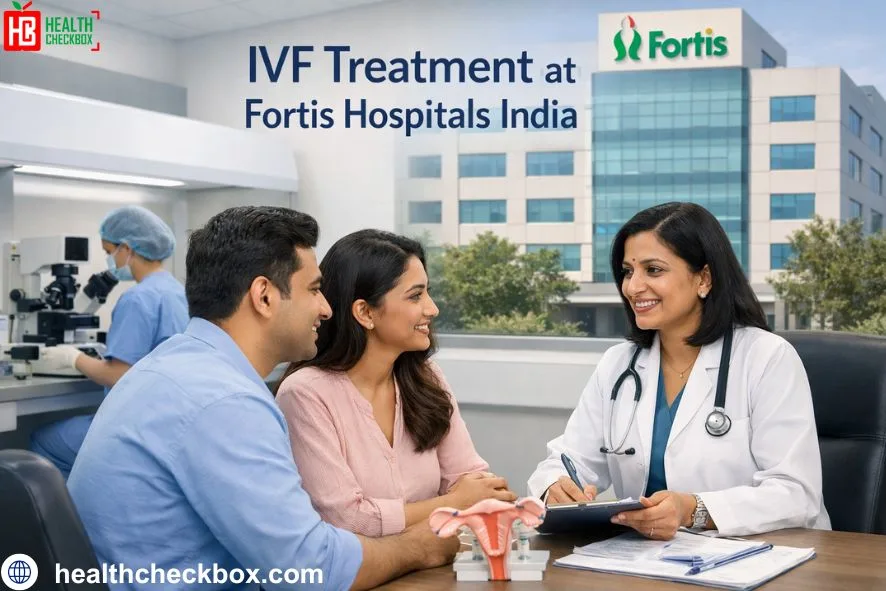
Having children is full of promise, anticipation and happiness as they welcome a new phase in their lives. At the same time, infertility poses unexpected challenges to many couples. Any number of things can cause it. The modern medical studies are evolving at a rapid rate and continuously discovering something new providing hope to humankind. One such gift is IVF treatment for all those couples who are unable to conceive children naturally. India is one of the leading countries for IVF treatment. With some of the most advanced technology and highly qualified medical staff at affordable prices. Fortis Hospital is one of the best hospitals in India, because of its best medical facilities, qualified employees, and affordable prices. The Fortis Hospitals in India are one of the most ideal places to have IVF treatment. Since their specialists are known worldwide, and their personal attention is the most successful.
What is IVF?
IVF is the process of extracting ovarian eggs and fertilizing them in a laboratory using sperm. It is also widely suggested for those couples who have infertility problems. Or couples suffering from disorders such as endometriosis, blocked fallopian tubes, or PCOS. The number of IVF cycles required varies depending on individual fertility factors. It is, in fact, different to individuals. According to most doctors, one should plan on about three to four cycles. But others can require up to six or more. Age, quality of the embryos, etc are some of the factors that affect the success of IVF treatment in India. It is also dependent on lifestyle habits and underlying health conditions.
IVF treatment process at Fortis Hospitals India
The doctor will perform a number of tests prior to starting IVF. These examinations contribute to the formation of the full image of your well-being. The objective is to know the cause of infertility. In women, hormones such as FSH, AMH and estradiol are tested during this stage. FSH is used to determine the functionality of the ovaries. AMH denotes the reserve of the ovaries, i.e., the number of eggs left. The amount of estradiol is used to assess general hormonal balance. Women may also be suggested to undergo a hysteroscopy.
This examines structural abnormalties within the uterus. In men, a semen test is conducted to evaluate sperm count, motility, and morphology for successful fertilisation. This tests the count, motility and morphology of sperm. These are the factors that directly influence the fertilisation success. Both of the partners are also examined on infections. HIV, hepatitis B, hepatitis C and syphilis testing are included. This is because it makes the IVF process safe and healthy.
Preparation Before IVF
One cycle of IVF takes about 2-3 weeks to complete. The doctor advises that people should be prepared for more than one cycle. Before the start of the process all the patterns and time frame of the menstrual cycle are observed. After analysing the menstrual period of the women the 5 stages of IVF are performed by the doctor which are as follows:
Ovarian Stimulation
The doctor requires multiple eggs because some may not fertilise. Different procedures require different kinds of drugs. Patients are primarily given hormonal medication injections by the doctors. It could include either luteinizing hormone (LH), follicle-stimulating hormone (FSH), or both. Patients who receive these doses are able to produce several eggs at once. Following that, the patient is monitored for egg maturation using hormone testing and ultrasound. The ovulation-inducing shot is given to the patient 36 hours before the egg retrieval.
Egg Retrieval
This procedure involves removing multiple eggs from one or both ovaries. Egg retrieval is usually performed 34–36 hours after the trigger injection. To help you relax and manage the pain, the doctor gives medication. Thin needles guided by the ultrasonic equipment are used to extract the eggs from the follicles, which are sacs in the ovaries. It can take up to twenty minutes. The retrieved eggs are placed in a specialised culture medium in the laboratory before fertilisation.
Fertilization
IVF treatment in Fortis Hospitals in India commonly uses two methods to fertilise the eggs. Which are conventional insemination and intracytoplasmic sperm injection (ICSI). In conventional insemination, the healthy sperm are combined with mature eggs in incubators that control the environment. whereas in Intracytoplasmic sperm injection, a single healthy sperm is injected into each mature egg. This method is used when sperm quality or number is an issue.
Embryo Transfer
Embryo transfer occurs two to six days following egg retrieval. Generally, it is a quick and painless procedure and usually does not require anesthesia. After that, a long, thin tube called a catheter is inserted into the uterus. A syringe containing one or more embryos is connected to the catheter. The syringe is used to insert the eggs into the uterus. You may have slight cramping or swollen ovaries following the operation, but these symptoms will eventually fade away. After embryo transfer its essential that the woman take care of herself and eat healthy food. This good lifestyle may support the embryo transfer success rate. Some of the foods to eat after embryo transfer include Walnuts, Plant Based Protein, Strawberries, Peaches and oranges.
Pregnancy Test
The pregnancy test is performed after at least 12 days. The patient is directed to a pregnancy expert for prenatal treatment if the results are positive.If not, the patient may decide to halt the procedure or try another IVF cycle.
The Success of IVF
IVF success is never a universal process. Fortis Hospitals India offers individual care and attention to each patient. There are many factors affecting IVF success rate in India. The largest factor in the IVF outcomes is age. The younger women below 35 years have a better success rate. The health of the sperm and the quality of the egg are also crucial. IVF outcome can be influenced by many conditions such as PCOS or endometriosis. Fortis Hospitals India believes in IVF Treatment that is backed by high-technology and specialists. The labs on embryology are highly internationalised. Physicians design individualised guidelines to all patients. When the time is right, most couples get to have the family of their dreams. Each of the cycles is more illuminated and optimistic.
Risks of IVF Treatment
Generally, IVF is safe, and every medical operation has a few risks. Nevertheless, knowing makes you feel more like yourself. The risks will never be withheld at any time by your doctor. The idea is to achieve your safety and wellbeing during the IVF journey. Some of the risk factors in IVF are:
- Ovarian hyperstimulation syndrome or OHSS. It leads to swollIing ovaries following stimulation.
- Mild cases of OHSS tend to disappear on their own in several days. In the case of severe ones, medical intervention may be required.
- The potential risk of IVF is multiple pregnancies. This is enhanced when more than one embryo is transferred. Multiple births may cause early or underweight births.
- The retrieval of the egg has the risk of bleeding or getting infected.
- Emotional stress is also a very realistic side effect. This may be overwhelming in the process.
Fortis Hospitals in India
In India, Fortis Healthcare Limited is a top provider of integrated healthcare delivery services. The Fortis Group has around 36 medical facilities in 12 states. They seek to provide India with a top-notch healthcare system that combines the best medical expertise with caring patient care. It is considered one of the best IVF hospitals in India because they have shown a high success rate. There are skilled professionals like Dr. Prabhleen Kaur, Dr. M. Gauri Devi and Dr. Hrishikesh Pai who are continually working in the field of infertility medicine.
Fortis Bloom IVF Centre, Greater Kailash
Fortis Bloom IVF has access to specialised treatment facilities and the best equipment. It has over a thousand procedures done over the period of 30 years and is under the leadership of Dr. Hrishkesh Pai and Nandita Palshetkar. They are the first to employ a combination of egg donation and surrogacy with three mothers, and the first to adopt laser hatching and blastocyst culture which is meant to improve the pregnancy rates.
Dr. Hrishikesh Pai
Dr. Hrishikesh Pai is a good gynecologist in the nation. He is the immediate Secretary General of Federation of Obstetric and Gynaecological Societies of India (FOGSI). In the year 2006, Dr Pai was the Senior Vice President of FOGSI. He is the founder of many medical innovations like development of spindle vision and aided laser hatching.
Dr Nandita P Palshetkar
Dr. Nandita P. Palshetkar happens to be a highly qualified laparoscopic surgeon and infertility expert. She is an obstetrics and gynaecology specialist of more than 30 years with teaching and professorial experience at the Dr D.Y. Patil Medical College, Navi Mumbai. And the Reproductive Medicine Fellowship in the Lilavati Hospital, Mumbai.
Fortis Hospital, Shalimar Bagh, New Delhi
Fortis Hospital Shalimar Bagh is one of the highest ranked multi-superspecialty hospitals of Delhi, and it was launched in the year 2010. One of the biggest hospitals in the region. The assumption is that the facility develops a mixture of medical devices and humanitarian treatment which are highly technologically developed. High-quality clinical care, patient satisfaction, and the achievement of great results. IVF Centre of the Fortis Hospital, Shalimar Bagh, is a reputable reproductive clinic which can help to make a dream come true. The hospital consists of 375 beds in operation with 18 emergency wards.
Dr. M. Gauri Devi
Dr. M. Gouri Devi is a well known gynecologist and obstetrician with her head office in Delhi. She began working in 1974. Today, she is the Director of Gouri Hospitals and the Director of the Department of Reproductive Medicine in Ridge IVF. In 2018 to 2020 She served as the President of the Indian Fertility Society and as the vice president of the Fertility Preservation Society of India currently. Her dedication to bettering the field of reproductive medicine still remains a source of inspiration to many people and families.
Dr. Prabhleen Kaur
Dr. Prabhleen Kaur’s area of interest is extremely broad, encompassing fertility preservation and infertility treatment. This involves IVF and IUI, and endoscopy, which makes her experience and reputation trusted by her as a reliable specialist in reproductive medicine.
Cost of IVF Treatment in India
IVF cycle will cost an average of INR 1,00,000 to INR 4,00,000. The price may either go up or down based on various factors, including additional procedures and treatments, where the patient is, and reputation, among others. The experts advise that one must prepare for multiple cycles, as there is no guarantee on how many IVF cycles are needed to get pregnant. Prior to the procedure, one should seek a professional and ask them about the prices and information about any other inquiries. It is recommended that as much information as possible should be collected prior the process being initiated so as to prepare the couples mentally, physically and financially to care about the child.
Conclusion
IVF is a journey that requires a great deal of willpower, perseverance, and determination. They might experience numerous setbacks. For many couples, IVF treatment at Fortis in India provides hope. Their world-class technology and qualified specialists at an affordable price ensure that the child’s dream is available to everyone.