

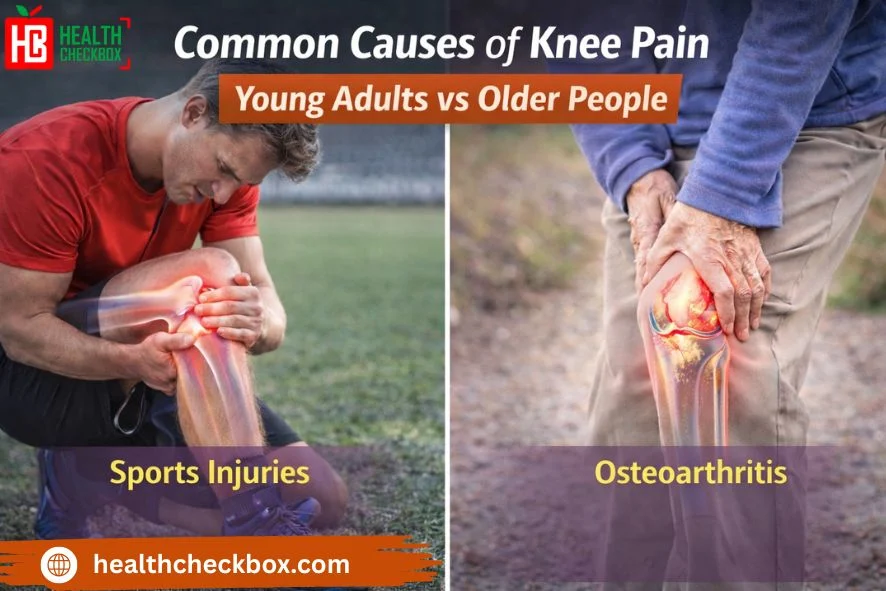
Knee pain is very common nowadays in people of every age. Whether you are young or old, knee pain can occur at any point in time. Knee pain can give a feeling of discomfort, which can be caused by an injury, ruptured ligament or torn cartilage. High-impact sports, overexertion, and muscle imbalance are common causes of knee pain in young adults. However, osteoarthritis, prior injuries, and placing too much weight on the knees are common causes in older persons. In this article, we will discuss the common causes of knee pain in both young adults and old age people, including symptoms, care, treatments and risk factors.
What is Knee Pain?
Knee pain is very common at every age. This can be caused due to excessive-exercise, hypertension, and other causes. Knee pain comes with slight discomfort, redness or swelling can occur. There are some common symptoms for knee pain which include reduced range of motion, instability and a locking or grinding sensation. There are various types of pain which can be acute and chronic. They can occur in any region of the knees.
Treatment for the knee pain can be different depending on the pain. For minor pain, we can get some rest, use ice, compression and other methods. For chronic pain we need to consult a doctor and might get physiotherapy and medication involved.
Common Causes of Knee Pain in Young Adults
The causes of knee pain in young adults are mostly due to their modern lifestyle. Because they have to sit for long hours in the office, poor posture, intense workout or sports injuries.
- Long Sitting Hours: Continuously sitting for 8 hours straight in the office will eventually lead to weakened hips. Putting extra weights on the knee joint can cause anterior knee pain and PFPS in young adults.
- Excessive Workout or Sports: Overdoing the gym exercise and sports activities can lead to damage in knee joints
- Old Injury: Previous injury like muscle tear or ACL tear, if left untreated can increase the risk of arthritis in the future if the tear is not fully healed.
- Patellofemoral Pain Syndrome: This is due to misalignment or imbalance, which causes pain in the back of the kneecap
- Ligament Injuries: its most commonly caused by twisting movements of the body during badminton, and can eventually lead to knee pain, swelling and lead to instability.
- Meniscus Tear: A spontaneous movement or a twist can cause the meniscus tear, which can give persistent pain to the knees.
- Early Cartilage Wear: Repeating the same stressful activities can lead to softening of the knee cartilage, which can cause pain in the knees.
Common Causes of Knee Pain in Old Age People
The primary cause of knee pain in old age is osteoarthritis. It is a type of joint disease and can cause the breakdown of cartilage and underlying bone. This results in pain, stiffness, and reduced mobility, chronic knee pain due to rheumatoid arthritis, previous injuries, and age-related muscle problems.
- Osteoarthritis: The most common knee problem in old people, which involves the gradual erosion of cartilage, which leads to pain and stiffness in the knee joint.
- Excessive Body Weight: Obesity puts pressure on the joints, which leads to increasing pain and joint degradation.
- Previous Injuries: Old injuries like muscle tear, ACL surgery can lead to arthritis.
- Muscle Weakness: It’s a very common cause of knee pain as a person is gradually losing the muscle mass from the joint. which leads to difficulty in mobility, strength and function of the knee.
Differences in Symptom Presentation by Age
The symptoms of knee joint pain may vary from person to person. Because causes of knee pain for young adults and for older people might also be different. Younger patients tend to get pain, swelling and instability from playing sports and excessive exercising. On the other hand, the old people report stiffness, grinding sensation and dull aches associated with cartilage breakdown.
Symptoms by Age
Usually, pain is located near the kneecap, arising from issues like a swollen bump below the knee. Actions that lead to pain can be triggered by jumping, running, and sometimes limping, too.
Young Adults (20s-40s)
There are various causes of knee pain in this young age like excessive exercise, which leads to pain and swelling. Athletes get their knees overused as they run all the time and it may cause excessive pain in their kneecaps. Injury is a very common cause of knee pain in which you feel acute and sharp pain often with rapid swelling and locking of knee which usually indicate ACL tears.
Middle-Aged People (40s-50s)
This is the stage where the people start to get early stages of osteoarthritis which causes stiffness, swelling and the pain. This increases overtime while doing activities.
Older Adults (60+)
In older people, the common cause of knee pain starts from a dull and persistent ache that can be felt around the knees. But after some time, the pain worsens due to immobility of the knees. On the other hand we can also hear crackling and grinding sound from the joint which results in cartilage loss. The muscle also weakens due to muscle weakness which leads to instability.
How Can You Diagnose Knee Pain?
For diagnosing and evaluating the knee pain, doctors do a comprehensive research or approach. It involves medical history, physical examination, and imaging techniques that can help to identify the causes of knee pain.
Diagnosing the knee pain can be done in various manner like:
- Physical Examination: The doctor will check the range of motion, swelling, redness, how far you can stretch your lower leg in different directions or the doctor can push and pull the knee to check its integrity of the structure.
- Imaging Techniques: There are various imaging methods which can be done to diagnose the knee pain problem:
- X-ray: It will help us to identify bone fracture and degenerative joint disease.
- CT Scan: It helps us to diagnose subtle fractures.
- Ultrasound: This technology uses sound waves to produce a real time image of the soft tissue around your knees.
- Arthroscopy: A small amount of fluid is taken from the knee joint to identify the infection or inflammation in knee joints.
- MRI: Uses radio waves and a powerful magnet to create 3D images of the knee.
Treatments for Knee Pain
Treatment depends on the health conditions or the patient’s age.
Medication and Braces
Doctors can prescribe medication which can help get relief from the pain and treat the problem that is causing the knee pain. Using knee braces after surgery is also the best option for speedy recovery.
Physical Therapy
Therapy helps to strengthen the muscles around the knee to support it better. That can increase the flexibility and decrease the pressure from the joint pain.
- Injection: Sometimes the doctor suggests injecting the medication directly to the knee joints.
- Corticosteroids: Reduce the symptoms of arthritis to the knee and provides pain relief.
- Hyaluronic Acid: Hyaluronic acid injections for knee pain are a good option because they are injected to decrease the knee pain.
- Platelet-Rich Plasma: It contains concentration of many different growth factors and sometimes it promotes healing.
Surgery
It totally depends on the doctor’s advice on whether to get surgery or not. First, do research on the non-surgical procedures which can be done and your knee may get healed naturally. If you really opt for surgical procedures, then check out the arthroscopy, partial knee replacement & total knee replacement:
- Arthroscopy: This procedure can be used to remove the loose bodies from the knee joints, repair damaged cartilage or reconstruct the torn ligaments.
- Partial Knee Replacement: In this procedure, the surgeon only removes the most damaged part of your knee and replaces it with metal and plastic.
- Total Knee Replacement: Total knee replacement surgery, the damaged bones, knee cap, thigh bone and shinbone are replaced with artificial materials.
What are the Risk factors for Knee Pain?
There are multiple risk factors that can lead to knee pain:
- Obesity: Extra weights tend to put a lot of pressure on the knee joint which can lead to cartilage breakdown and knee pain.
- Previous Injuries: A prior injury that can be from years ago, makes it highly liable that person will get knee pain in the future.
- Weakness: Muscles that are weak, particularly in quads and hamstrings, can fail to support the knee joints.
- High Sport Activities and Stress: Sports that involve jumping, running, sudden movements, such as basketball and football, can increase the chances of ligament tear or cartilage damage.
- Ageing: Aging is the major factor in causing the degeneration of cartilage and feeling the grinding in the knees.
Conclusion
In this article, we have covered all the information about the common causes of knee pain in both young adults and old age people. Knee pain is a very common cause at every age and the reason can be excessive-exercise, aging and many more. The article has also mentioned how you can diagnose knee pain and what treatments are available to fix knee pain issues. Along with it, we have also mentioned the risk factors that people have to take care of and avoid getting knee pain in future.