

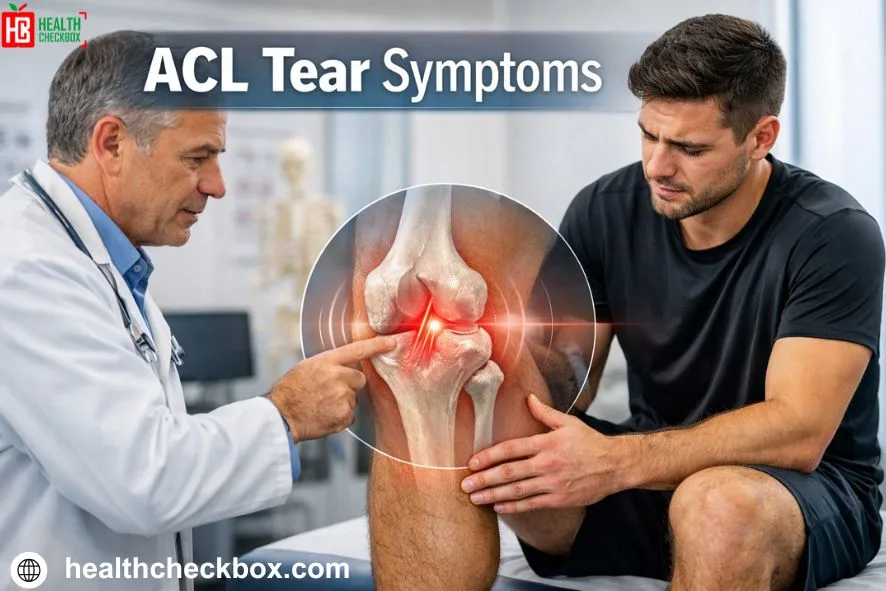
ACL (Anterior Cruciate Ligament) is a crucial ligament which joins the thigh bone to the shin bone. It helps to provide stability and prevent shin bone to stop going forward and controlling rotation. The symptoms of ACL tear are hearing a pop sound in your knee, making your range of motion due to pain or swelling in the knee area. The risk of having ACL injuries is higher in females compared to males. Because they have small intercondylar notch, as compared to men. We don’t want to ignore these symptoms as they lead to long term damage like instability, risk of damaging the meniscus. Also, it can lead to arthritis.
Understanding an ACL Tear and ACL Strain
ACL tear is a condition where the ligament is torn. ACL tear is a serious knee injury, which leads to severe knee instability, popping sound, loss of motion and significant swelling in the knee cap area. Whereas, an ACL strain is divided into grades at which the ligament is stretched or completely ruptured. Grade 1 is considered to be a mild stretch, grade 2 is a partial tear, and grade 3 is crucial as the ligament is completely torn.
A partial ACL tear is when some fiber of the ligament are torn and some stay intact. The knee can be stable with the remaining fibers but functionality can still be impaired. People with Partial ACL tears may feel mild or moderate pain and swelling along with some instability during some movements. On the other hand, a complete ACL tear is when there is a total rupture of ligament, rendering it incapable of stabilizing the knee. This occurs when you suddenly stop, change the direction or land improperly. When injury occurs, people hear a popping sound and after that, the swelling and severe pain start.
ACL Injuries are more common in athletes which play football, basketball and other sports. It involves rapid change in direction, sudden stop or improper landing after jumping. ACL injury can also be caused by getting into an accident like falling from the stairs, motor vehicle accident, and workplace injury.
Most Common Symptoms of ACL Tear and Strains
- Popping Sound: Audible Pop sound will be there at the time of the incident. But, it is not necessary that bone is broken.
- Swelling: After the incident, swelling will be there which means that there is a bleeding in the joint.
- Instability: It’s a feeling that the knee is weak, unstable and you are limping due to instability of the ACL.
- Pain: You will feel intense pain in the knees when you put pressure on them.
- Range of Motion: You will not be able to walk or feel loss of motion due to ACL surgery.
- Inability to Walk: You will not be able to walk properly without any instability in the knees.
Symptoms of a Mild ACL Strain
A mild ACL strain is considered to be Grade 1 sprain which typically involves minor ligament stretching and it can cause mild pain, but you can bear weight. The symptoms are mentioned below:
- Mild Pain: Discomfort will be there, especially when you touch your knees or try to move them.
- Minor Swelling: The Knee might become slightly swollen and puffy but not as severely ruptured.
- Stability: The knee will be slightly unstable or weak but not as the full tear feeling.
- Range of Motion: There will be a slight motion stiffness but most of the motion range is retained.
Symptoms that May Indicate Associated Injuries
Here are the early signs and symptoms that may cause knee injuries:
Meniscus Damage
The meniscus is a C-shaped piece of rubber cartilage that acts as a shock absorber between the thighbone and shinbone. It can be damaged by any activities that involve twisting, or degenerative scenarios and it is most common in athletes.
- Pain: It gets painful on the side of the knees, if we twist or do squats with them.
- Swelling: The knee becomes swollen and stiff.
- Instability: A feeling that the knee is unstable and giving away.
MCL
The MCL is full of connective tissues that runs from the medial epicondyle of the femur to the medial condyle of the tibia. It is one of the four major ligaments that help maintain the knees. This is very common in athletes which plays basketball and football, which requires sudden movement and twisting of the knees. There are various types of the MCL tear:
- Grade 1: It is referred to as a mild tear in MCL, where fibers in your ligaments are torn and your knee is already stable.
- Grade 2: It is referred to as moderate tear in MCL where your MCL is a partially torn superficial part of your MCL. The knee will be loose and there will be pain inside your knee.
- Grade 3: It is referred to as a severe pain in which the MCL is completely torn from both the superficial and deep parts. The knees will be unstable and loose and you will feel intense pain.
Locking or Catching Sensation in the Knee
The locking and catching sensation in the knee occurs when the person is not able to bend and straighten their knees. The causes for this can be structural damage like meniscus tear, loose cartilage fragments and many more.
- Meniscus Tear: A torn piece of cartilage which can prevent bending the knees as it can get caught in the joints.
- Ligament Injuries: Tears in ligaments can cause instability and locking sensation.
- Pseudo Locking: It is considered to be a false lock which temporary causes pain to surrounding to muscles spasm and freeze the joints.
- Knee Dislocation: The Kneecap slips out of place, causing the knee to lock.
When to see the Orthopedic Specialist?
See the orthopedic specialist when you have knee pain or face other orthopedic issues symptoms, if you have any swelling or are experiencing pain in the knees. Also, if you are unable to bear weight or you hear any popping sound during injury.
Symptoms that Require Immediate Attention
- Persistent Pain: It means that if the pain continues even after taking rest, it may indicate a deeper issue which need to be diagnosed
- Limited Range of Motion: If you face difficulty bending the knees and straightening them, then it might be structural damage.
- Pooping or grinding sensation: Clicking, popping or grinding in the knees can result from cartilage damage or arthritis.
- Visible deformity and fracture: A bent or misshapen knee following injury may require urgent medical care
Importance of Early Diagnosis
An early detection or diagnosis of knee pain is crucial as it can prevent further, irreversible joint damage and many more. By identifying the root cause of the discomfort feeling, the doctor can give the treatment according to your problem.
- Timely Intervention: Early diagnosis helps the doctor to implement the effective treatments before they get worse.
- Customized Treatments: Customized treatment plans are given by the doctor based on the conditions of the patient.
- Improved Pain Management: Early diagnosis allows for the implementation of pain management strategies that target the root cause of your discomfort.
- Enhanced Mobility: By identifying the knee problem in the early stages, patients can regain and maintain better mobility. This encourages them to the physical activities and improve their whole physical healths
Diagnostic Tests (Physical Exam, MRI, X-ray)
- Physical Exam: The doctor will inspect the knees for any swelling, redness or any pain. They will check how far your legs are stretching and pull or push the joints to check the integrity of the structure in your knees.
- X-Ray: This helps to detect bone fracture and degenerative joint disease.
- CT Scans: It combines multiple X-rays from different angles to create a cross-sectional image.
- Ultrasound: Uses sound waves to produce real time images of soft tissue structures with or around your knees.
- MRI: Uses radio waves and magnets to create 3D images of your knees.
What happens If you Ignore ACL Symptoms?
Ignoring the ACL symptoms like Instability, pain, and swelling can lead to chronic knee pain, recurrent giving away, and accelerated damage to cartilage and meniscus.
- Irreversible Damage: The meniscus and cartilage can be damaged severely if the knee remains unstable.
- Complete Tear: A partial ACL tear may worsen into a full tear, often making surgery the only viable option.
- Less Functional: Difficulty in doing daily activities, such as walking, climbing stairs.
- Longer Recovery: Delayed treatment often results in a more complicated recovery, affect the recovery time of ACL surgery and rehabilitation process.
ACL Tear Symptoms Between Athletes and Non-Athletes
ACL symptoms are similar in both the athletes and non-athletes. Most of the injuries in athletes are caused by non-contact. Whereas, the non-athletes get injured in doing their day-to-day activities.
ACL Tear Symptoms of Athletes:
- Mechanism of Injuries: Most of the injuries are non-contact, which involve rapid cutting, stops and awkward landing.
- Instability: It is mostly felt at the time of doing high-intensity workouts.
- Swelling and Functionality: Both experience rapid swelling and less functionalities but for the athletes this can be more dramatic and may report limited functionality.
ACL Tear Symptoms of Non-Athletes:
- Mechanism of Injuries: Injuries can occur due to tasks like simple twisting, slipping or in some cases low-velocity activities.
- Instability: It can be felt while walking on uneven ground or descending stairs.
- Swelling: Swelling may occur within the first few hours.
In both the scenarios, a pop sound is heard and immediately severe pain and often making it impossible to do the activities.
Prevention and Early Action
Prevention and early action taken against knee pain involves multiple exercise that can strengthen the supporting muscles, managing body weight and adopting proper movement mechanics to avoid the long-term joint degradation.
- Lifestyle modification: Maintain a healthy body structure, which can help reduce the pressure on the joints and can ease pain.
- Medication: It can help to manage and ease pain in the knees and stronger medicine can provide relief for longer periods and can delay the surgery.
- Physiotherapy: Physiotherapy plays a crucial role in maintaining the knee pain with the help of custom exercises which are specially designed to ease the pain and improve mobility.
- Ensure proper posture: Improve your posture during exercise, such as keeping knees in line with knees during squats.
Conclusion
This article includes all the information about how the symptoms of an ACL tear can lead to long-term damage to the knee and its causes instability. Persistent pain, swellings and popping sounds at the time of the impact are a warning sign that we should not ignore. Early diagnosis and proper treatment are essential to prevent them from worsening from any future complications such as cartilage damage or arthritis.